Parent consent controls access
Families decide what is shared and who can view a child’s activity, keeping participation transparent and parent-guided.
For therapists and practitioners
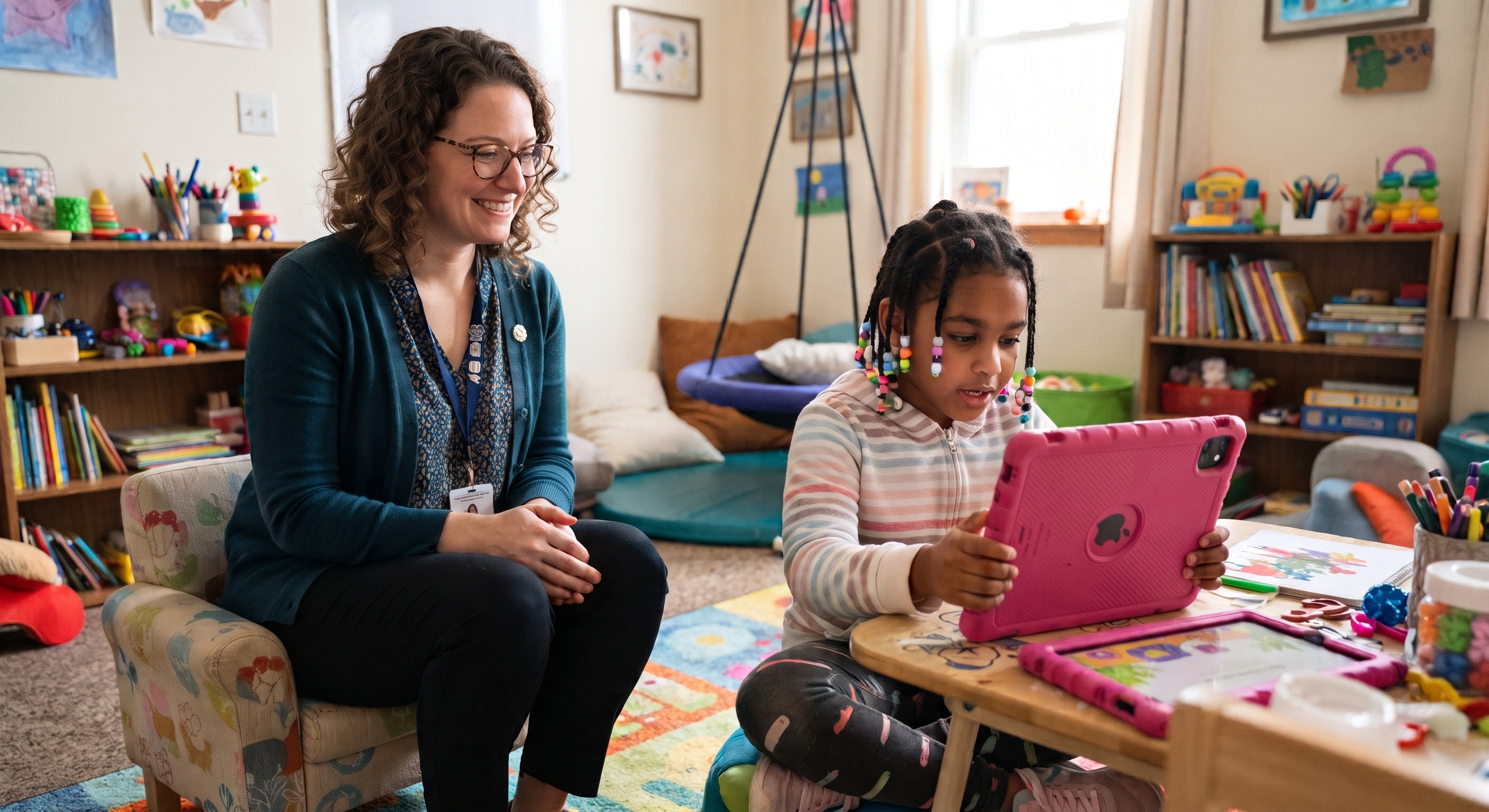
StoryMii gives therapists a richer view of how children read, create, focus, and express themselves—so sessions can begin with curiosity instead of assumptions.
Observation support, not diagnosis. Clinical interpretation stays with the professional.
A fuller picture
Patterns worth exploring.
A different kind of dashboard
The therapist view brings together the child’s activity, choices, and creative work so you have better questions to bring into a session.
Notice starts, pauses, returns, session length, and which activities hold attention.
Explore listening, reading, vocabulary, comprehension, and repeated passages.
See themes, characters, drawing time, revisions, and choices over time.
Notice when children begin, choose, persist, and complete with less support.
The practitioner view
Explore one dimension at a time, then connect it to the child’s own story, context, and voice.
Maya · sample observation
average creative session
18 min
Longer sessions during story-making
Pattern over recent sessions
A question to explore
What changes when the child can listen before reading?
Use the pattern as a conversation starter—not a conclusion.
ADHD- and dyslexia-informed support
StoryMii can help professionals observe how children respond to different ways of reading, creating, and participating.
Attention and engagement
Notice task initiation, sustained engagement, pauses, returns, switching, prompts, and completion across story-making and reading activities.
✓ Start-and-return patterns
✓ Response to multi-step prompts
✓ Preferred activity length and format
Reading and language
Explore listening, reading, replaying, vocabulary, spelling, comprehension, and confidence as part of a wider professional assessment.
✓ Audio-first versus independent reading
✓ Repeated words and passages
✓ Comprehension after different supports
StoryMii does not diagnose ADHD, dyslexia, or any other condition. It provides structured observations to discuss alongside formal assessment and professional judgement.
A practical workflow
01
See what the child chooses, repeats, avoids, and returns to.
02
Bring the pattern into a conversation with the child, family, or school.
03
Use the insight to shape the next prompt, ritual, or session activity.
04
Compare changes over time without reducing the child to a score.
Privacy and professional boundaries
Parents control access, children are not reduced to a score, and professionals remain responsible for interpretation and care decisions.
Families decide what is shared and who can view a child’s activity, keeping participation transparent and parent-guided.
Stories, drawings, and personal details are treated with care—not exposed as public profiles or shared without permission.
Activity can prompt thoughtful questions, but it does not label a child or replace validated assessment and professional judgement.
Use a child’s interests, preferred formats, and observed choices to shape supportive activities and family conversations.
See the practitioner view
Request a walkthrough and explore how StoryMii could fit alongside your existing practice.
Their next adventure starts here
Our partners